REVIEW · DUBROVNIK
Dubrovnik Old Town Walking Tour with Audioguide
Book on Viator →Operated by TouringBee · Bookable on Viator
A walk that teaches you while you wander. This self-guided Dubrovnik Old Town route pairs a timed route with audio at 24 key stops. You’ll move through famous landmarks, monasteries, fortresses, and sea views at your own pace.
I especially like the offline map + GPS route setup. You download, press play, and the app keeps you pointed the right way without needing a human guide. I also like how the audio is built for a short visit, with entertaining history that hits obvious highlights like Jesuit Stairs and Game of Thrones filming locations.
The main drawback is also the nature of audioguides: if you’re not comfortable downloading and getting your phone working, the start can feel a bit fiddly. Also, bring your own headphones—this won’t be comfortable if you rely on whatever your phone already has.
In This Review
- Key points to know before you go
- A Self-Guided Route That Fits a 2-Hour Dubrovnik Break
- Getting Started at Mirador Brsalje and Using the Offline Map
- From St. Lawrence Fortress to Pile Gate: Your Route Begins With Power
- Onofrio’s Large Fountain and the Street Geometry of Stradun
- Orlando Column, Saint Blaise, and the Onofrio Small Fountain Stops
- Sponza Palace, Rector’s Palace, and the Government-Minded Side of Dubrovnik
- Monasteries and Churches: Quiet Breaks in the Middle of the Walk
- Gundulićeva Poljana Market: A Real-Life Pause for Local Food and Color
- Game of Thrones Moments: Jesuit Stairs and Filming-Locations Audio
- Fortresses and Sea Views: Revelin, St. John’s, and Porporela
- After the Walk: Maritime Museum or a Swim by Your Own Schedule
- Price and Value: What $8.34 Buys You (and What It Doesn’t)
- Who This Audioguide Tour Fits Best
- Should You Book This Dubrovnik Audioguide Tour?
- FAQ
- FAQ
- How long is the Dubrovnik Old Town walking tour with audioguide?
- How much does the tour cost?
- Is this tour guided by a person?
- What do I need to bring?
- Where does the tour start?
- Does this tour include the Old City walls?
- What’s included with the audioguide?
- What attractions does the route cover?
- Is there a mobile ticket?
- Can I cancel for free?
Key points to know before you go

- 24 points of interest along the Old Town route, with audio recordings for each stop
- Offline map and route built for easy phone navigation (so you’re not hunting streets)
- Game of Thrones tie-ins, including the famous Jesuit Stairs and other filming locations
- Fortress and sea-view stops like St. John’s Fortress and Porporela for that classic Dubrovnik perspective
- No city wall walk included, so plan a separate visit if that’s a must for you
A Self-Guided Route That Fits a 2-Hour Dubrovnik Break
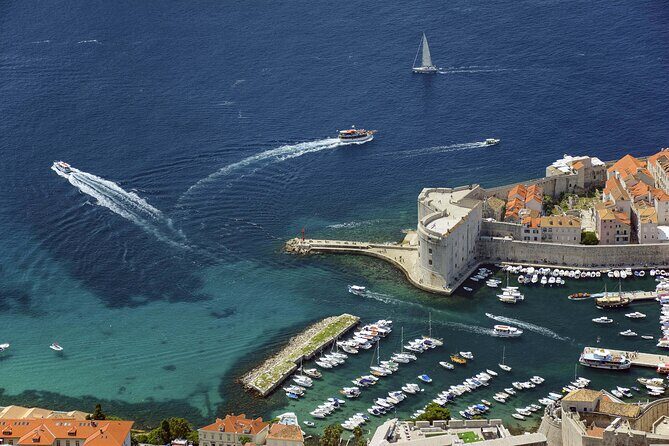
Dubrovnik Old Town can feel like it’s all “must-see, must-see, must-see.” This tour gives you a smart way to keep it manageable: about two hours, 24 stops, and a mobile app that talks as you walk. It’s ideal when you want history and context, but you don’t want to lock yourself into a group pace.
You’ll start at Mirador Brsalje and end back there, so you don’t need to figure out a complicated return. The route is designed to take you through the thick of the Old Town sights rather than offering a scattered grab-bag of random photos.
Also, with a small max group size (the activity is capped at 20 travelers), you’re not usually dealing with a “herd effect” that can ruin the vibe of small moments like a church doorway or a fountain corner. Here, it’s more about your timing than your crowd management.
You can also read our reviews of more walking tours in Dubrovnik



Getting Started at Mirador Brsalje and Using the Offline Map
You meet at Mirador Brsalje, ul. 3, 20000 Dubrovnik. From there, you’ll follow the walking route on your smartphone. The tour is self-guided, meaning no person walks with you—so the app is your guide.
What makes this work (when it works well) is the included offline map with a pre-designed route. Even if cell service is spotty, the route and directions are meant to stay available. The audio also comes as preloaded recordings—so you’re not relying on streaming.
Two practical tips that matter:
- Download and test the app before you commit to the walk. If your phone needs time to register purchases or download content, you’ll want that done at the start, not halfway up a stairway.
- Bring your own headphones. The tour explicitly doesn’t provide them, and Dubrovnik’s Old Town is not the place you want to listen through speaker audio.
If you’ve ever started a phone-based tour and felt like you were wrestling with the interface, you’ll appreciate having a little buffer time. I’d rather you start early and relaxed than try to force it while you’re already walking.
From St. Lawrence Fortress to Pile Gate: Your Route Begins With Power
The tour opens with St. Lawrence Fortress, a stronghold that overlooks the Adriatic. Even if you don’t climb or spend forever here, the audio framing is useful because it sets the “why” behind the architecture: Dubrovnik’s fortifications weren’t decorative. They were protection.
Right after that, you head through Pile Gate, the iconic entrance to the Old Town. This is one of those stops where you don’t need a lecture to understand it’s important. The audio adds context so you see the gateway as part of a defense system, not just a photo location.
A helpful part of this tour is how it keeps switching between “big visual landmarks” and “short, meaningful pauses.” You stop long enough to get the audio point, then you’re back on the route. It’s a good rhythm for a limited time window.
Onofrio’s Large Fountain and the Street Geometry of Stradun

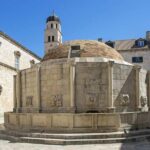
Next comes Onofrio’s Large Fountain, an obvious landmark in the Old Town with Renaissance-era significance. Fountains might sound like a small stop on a big sightseeing list, but in Dubrovnik, they help you understand the city’s planning—public water and public space tied together.
Then you move to Stradun, the main street. This is where the Old Town energy concentrates: the shopfronts, the walking flow, and the feel of the historic core all show up at once. The audio doesn’t just repeat what you can see; it helps you link the street to Dubrovnik’s past and the way the city functions.
Stradun is also a good “reset” moment. If your phone or headphones act up, this is where you’re most likely to find a quiet step-by-step place to fix it. It’s not a hidden corner—you can regroup right in the middle of everything.
Orlando Column, Saint Blaise, and the Onofrio Small Fountain Stops

From Stradun you pass the Orlando Column, tied to Dubrovnik’s medieval identity and independence. This is one of those landmarks where the audio helps you read it like a statement, not just a sculpture in stone.
Then you get to Church of Saint Blaise, a major religious building in Dubrovnik’s Old Town. The audio focus is on faith and architecture, and it works well if you like stepping inside when possible or at least pausing long enough to appreciate the exterior details.
You’ll also encounter Onofrio’s Small Fountain (15th century, per the route notes). This stop is short but clever: it turns a “you saw one fountain” moment into a comparison. You start to notice that Dubrovnik used these features as recurring symbols, not one-off decorations.
If you’re traveling with people who want photos only, you’ll still have an easy time here. These are the kinds of stops where you can let the audio play while you take pictures without feeling like you’re missing the point.



Sponza Palace, Rector’s Palace, and the Government-Minded Side of Dubrovnik

Two of the most important civic stops on the route are Sponza Palace and the Rector’s Palace.
- Sponza Palace is described as a Renaissance centerpiece tied to cultural heritage.
- Rector’s Palace is framed as a symbol of governance, so you understand why the architecture looks the way it does: it’s meant to project authority.
This pair works because it balances the religious stops (churches and monasteries) with the civic and political side of the city. Dubrovnik wasn’t only a holy place or a fortress—it was a functioning government and trading community.
If you like architecture but don’t want to spend hours reading plaques, audioguides are a good match. These stops keep your attention from drifting because the audio tells you what to look for and why it mattered.
Monasteries and Churches: Quiet Breaks in the Middle of the Walk
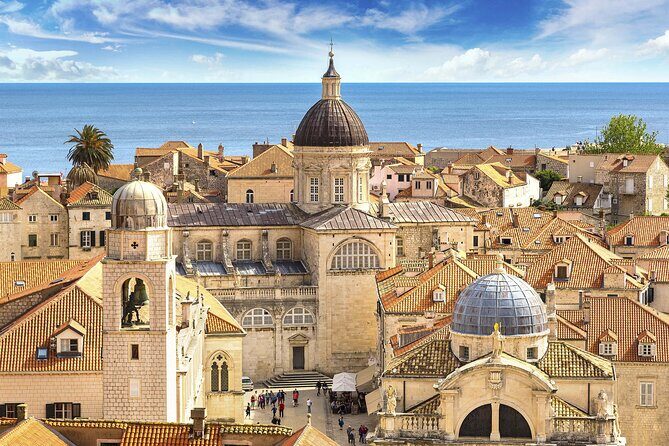
The route includes two monastery stops—Franciscan Monastery and Dominican Monastery—plus a major church stop at St. Ignatius Church and a cathedral stop.
You’ll also reach:
- Franciscan Monastery: presented as a serene spiritual and cultural site with cloisters
- Dominican Monastery: positioned as spiritual and architectural interest
- St. Ignatius Church: Baroque centerpiece with an ornate façade and serene interior; the audio mentions frescoes
- Cathedral of the Assumption of the Virgin Mary: Renaissance architecture and intricate artwork, with a stop designed for you to step inside if that’s possible during your visit
These are great for two reasons. First, they break up the pace of the “street-and-stone” sightseeing. Second, they give you a slower kind of attention—where you can actually hear the audio without shouting over the noise.
Practical note: don’t expect every church to be equally open or photo-friendly on your exact day. The audio still adds value if you can only spend a brief moment inside or at the doorway.
Gundulićeva Poljana Market: A Real-Life Pause for Local Food and Color

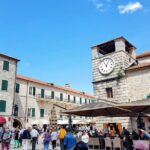
At Gundulićeva Poljana, you get a market stop with a focus on everyday local life. This is where the walk turns outward, away from landmarks and toward the kind of place locals actually use.
Even if you don’t buy anything, this stop helps your Dubrovnik picture feel complete. It’s easy to visit Old Town and only see the “historic postcard.” A market stop forces the question: what’s life like now?
That’s especially helpful if you plan to follow the tour with time at the Maritime Museum afterward or a swim after you finish walking. The market helps you shift from sightseeing mode to “city mode.”
Game of Thrones Moments: Jesuit Stairs and Filming-Locations Audio
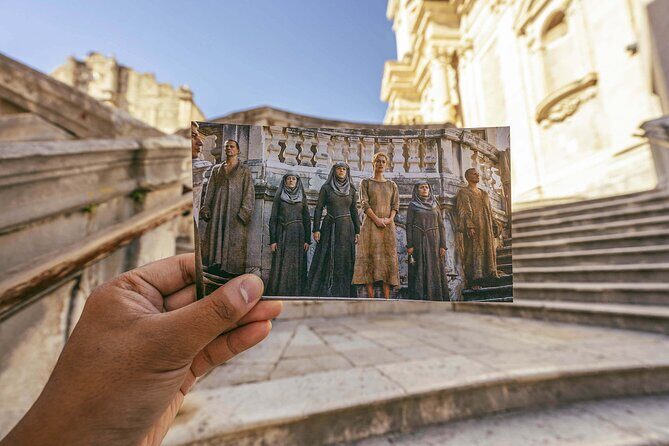
One of the best reasons to pick this route is that it explicitly builds in Game of Thrones filming locations, especially around the famous Jesuit Stairs.
The tour takes you to:
- Jesuit Stairs: 16th-century steps with panoramic views, highlighted as a Game of Thrones stop
- Additional Game of Thrones-related filming locations mentioned along the way
Even if you don’t obsess over the show, this works because the audio still explains the real place you’re standing on. You get the fun pop-culture hook, but you also get the historical context for why those stairs matter.
If you do care about the show, don’t just rush up to the viewpoint and move on. Pause long enough to let the audio play. The stories and descriptions are what connect the scene you know to the actual stonework and layout you’re seeing in front of you.
Fortresses and Sea Views: Revelin, St. John’s, and Porporela
Dubrovnik’s Old Town is defined by its relationship to the sea, and this route keeps returning to that theme through fortress stops and waterfront walking.
You’ll hit:
- Revelin Fortress, described as guarding the eastern entrance
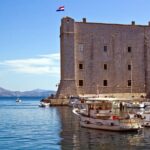
- St. John’s Fortress, described as a medieval stronghold; the route notes you can climb for panoramic views
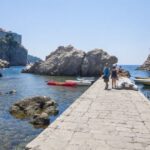
- Porporela, a historic breakwater with a stone pathway and sea views, including views toward the ancient walls
These parts are where you feel the logic of the city. Fortresses and breakwaters aren’t random scenery—they’re the physical infrastructure behind Dubrovnik’s survival.
Porporela also gives you a calmer, more “walk it slowly” moment. If you’re the type who likes taking in a view before the next stop, this is a good place to do it without breaking the flow of the audioguided route.
After the Walk: Maritime Museum or a Swim by Your Own Schedule
When you finish, the activity ends where you started at Mirador Brsalje. From there, you can choose your next move.
The tour notes two easy add-ons:
- Visit the Maritime Museum
- Go for a swim
I like having options after a self-guided experience because you aren’t stuck waiting for someone else. You can shift from walking to relaxing on your own timing.
If you plan to swim, just keep your phone and headphones protected while you still have your gear out. It’s not the kind of plan you want to turn into a scramble.
Price and Value: What $8.34 Buys You (and What It Doesn’t)
At $8.34 per person, this audioguide is priced like a budget win. And for many travelers, it is.
Here’s what you get for the money:
- An app for iPhone and Android
- Offline map and route
- 24 audio recordings tied to specific points
- Illustrations to help identify landmarks
- 1 year access in your preferred language
Here’s what you don’t get:
- No human guide
- No transportation
- No included headphones or smartphone
This is a tour for people who like self-paced exploration and who don’t need someone to answer random questions on the spot. If you want a conversation, this isn’t that.
But if you want a structured walk with real context, this price is hard to beat—especially in a city where you can burn hours on wandering without a plan.
Who This Audioguide Tour Fits Best
You’ll likely enjoy this tour if you:
- Have limited time and want a tight Old Town route
- Like learning history in small doses while walking
- Prefer flexibility over a timed group tour
- Want practical navigation support via an offline map
It might not be the best choice if you:
- Want a guided explanation with Q&A from a person
- Hate downloading apps or troubleshooting your phone while on vacation
- Plan to spend your entire visit walking the Old City wall (this tour explicitly does not include the wall walk)
Should You Book This Dubrovnik Audioguide Tour?
I’d book it if you want to see a lot of Dubrovnik’s highlights in about two hours, and you’re comfortable bringing your own headphones and using your phone for directions. The combination of offline routing, 24 recorded stops, and Game of Thrones–linked moments is a strong value for the price.
Skip it only if you know you’ll struggle with the tech side or if your top priority is the city walls. In that case, you’ll be happier with a different style of tour that matches your pace and expectations.
FAQ
FAQ
How long is the Dubrovnik Old Town walking tour with audioguide?
It’s listed as about 2 hours.
How much does the tour cost?
The price is $8.34 per person.
Is this tour guided by a person?
No. It’s self-guided using a mobile app with audio. There’s no human guide.
What do I need to bring?
Bring your own smartphone and headphones, since the headphones are not included.
Where does the tour start?
The meeting point is Mirador Brsalje, ul. 3, 20000, Dubrovnik, Croatia.
Does this tour include the Old City walls?
No. The Old City wall is not visited during this tour.
What’s included with the audioguide?
You get the audio guide app for iPhone and Android, an offline map with route, 24 audio recordings, and illustrations to help identify landmarks. You also have access for 1 year.
What attractions does the route cover?
The route includes stops such as Pile Gate, Onofrio’s Large and Small Fountains, Stradun, Sponza Palace, Rector’s Palace, monasteries and churches, fortresses like St. John’s Fortress and Revelin Fortress, and waterfront areas like Porporela.
Is there a mobile ticket?
Yes. The tour provides a mobile ticket.
Can I cancel for free?
Yes. Free cancellation is available, with a full refund if you cancel up to 24 hours before the experience start time.