REVIEW · DUBROVNIK
Dubrovnik Food and Drink Walking Tour with a Local Guide
Book on Viator →Operated by FABULA RAGUSEA · Bookable on Viator
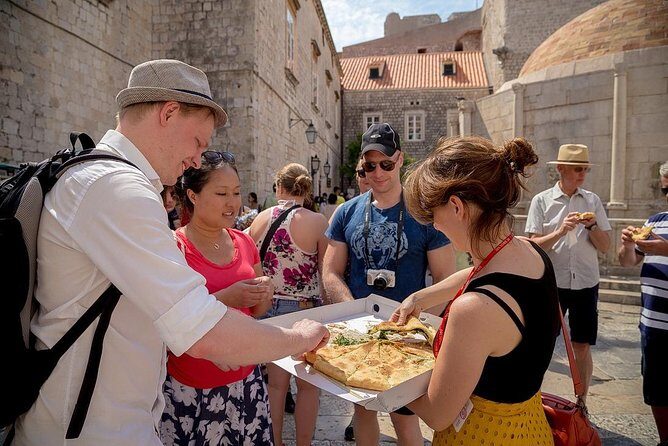
Dubrovnik tastes better when the stories come first. This 3-hour Old Town walking tour links food and drinks to the landmarks you pass every day, with a local guide keeping the focus on how the city worked, lived, and ruled. You’ll move at a comfortable pace through some of Dubrovnik’s best-known sights, then slow down for planned restaurant stops.
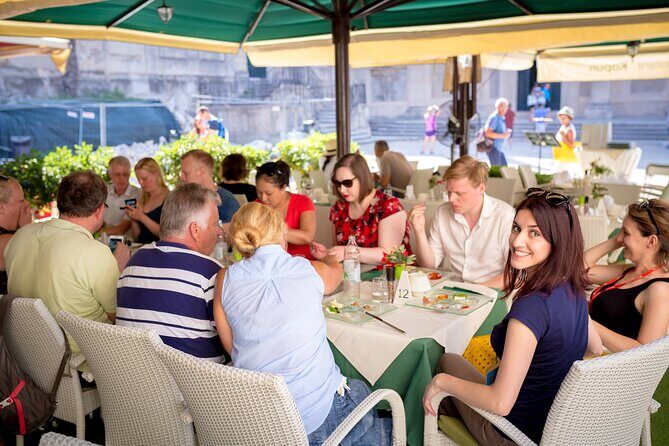
I especially like that the price covers food and drinks—starter, two main courses, dessert, plus coffee/tea, bottled water, and wine at multiple stops—so you are not doing math mid-meal. I also like the small-group feel (max 12), which makes it easier to ask questions and actually connect with the guide.
One possible drawback: it’s not a pure food buffet. You’ll spend time outside at key monuments and hear the context before you eat, and if you prefer lots of tiny bites with minimal talk, the format may feel more history-forward than you want.
In This Review
- Key takeaways
- A 3-hour Old Town walk where food has a schedule
- Starting at Poljana Paska Miličevića and cooling down at Onofrio’s Fountain
- Ruđer Bošković Square to the Rector’s Palace: how Dubrovnik organized power
- Saint Blaise and Stradun: the city’s symbols you’ll pass again later
- Gundulić Square Market and Sponza Palace: where trade becomes daily life
- Porat Dubrovnik and the Cathedral: maritime wealth meets spiritual power
- Orthodox Church of the Annunciation and Dubrovnik’s bell tower: a skyline with two stories
- What’s actually on the menu: barley with shrimps, Pag cheese, kopun salad, carob cake
- Alcohol, pace, and what to wear so you enjoy every stop
- Why this tour feels like an inside track in Dubrovnik
- Value check: is $175.35 a good deal?
- Who should book this, and who might skip it
- Should you book this Dubrovnik Food and Drink Walking Tour?
- FAQ
- How long is the Dubrovnik food and drink walking tour?
- What language is the tour offered in?
- Is the price inclusive of food and drinks?
- What is the maximum group size?
- Where does the tour start?
- Is there a vegetarian option?
- Is there a vegan option?
- Does it operate in bad weather?
Key takeaways
- All-in pricing for tastings means less menu stress and fewer surprise add-ons
- Small group, max 12 makes the walk feel personal and question-friendly
- History markers on the route (Onofrio Fountain, Stradun, Orlando Column, Sponza) turn meals into a timeline
- Wine is scheduled with the food at three stops, plus a liqueur with dessert at the last tasting
- Vegetarian option available, but vegan travelers should plan ahead since vegan option is not available
A 3-hour Old Town walk where food has a schedule
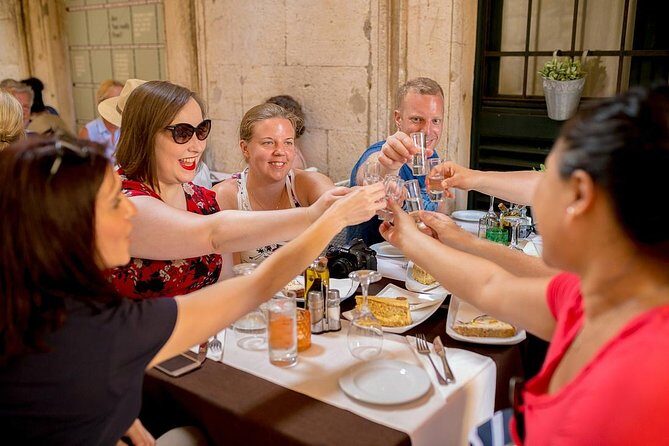
This is a straightforward format: you walk, you stop, you taste. The tour runs about 3 hours and is designed as a small-group loop through Dubrovnik’s UNESCO-listed Old Town area, so you’re not bouncing around the city.
The value is in the structure. You get coffee and/or tea, bottled water at three stops, and alcoholic drinks built into the tasting flow: wine at three stops and a local brandy or liqueur with dessert on the final meal stop. That matters in Dubrovnik because it’s easy to rack up spending when you’re buying small meals and drinks separately.
Also, the tour runs in all weather conditions, so dress for rain and wind. If you hate being on your feet for a while, plan for shoes that you can walk in comfortably on stone streets.
You can also read our reviews of more walking tours in Dubrovnik

Starting at Poljana Paska Miličevića and cooling down at Onofrio’s Fountain
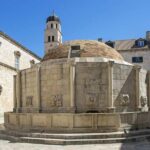
You begin at Poljana Paska Miličevića in Dubrovnik’s Old Town zone and start the walk right at Onofrio’s Large Fountain near Pile Gate. This isn’t just a pretty landmark. The fountain connects to Dubrovnik’s water story: it was built in 1438 by Italian engineer Onofrio della Cava and was part of a water supply system pulling water from a spring more than 7 miles away.
That’s a big deal because food tours can get stuck in the present. Here, the first stop gives you practical context for life in the old republic—how people got water, gathered at public sources, and rebuilt after major shocks. The fountain was damaged by the 1667 earthquake and also affected during the Croatian War of Independence, but it’s been restored and still serves as a functional public water source.
If you’re walking in warmer months, that first stop is a nice reset. You’ll get cool refreshment in the middle of the Old Town scramble, and it’s a natural place to gather before the route moves deeper into the historic core.
Ruđer Bošković Square to the Rector’s Palace: how Dubrovnik organized power
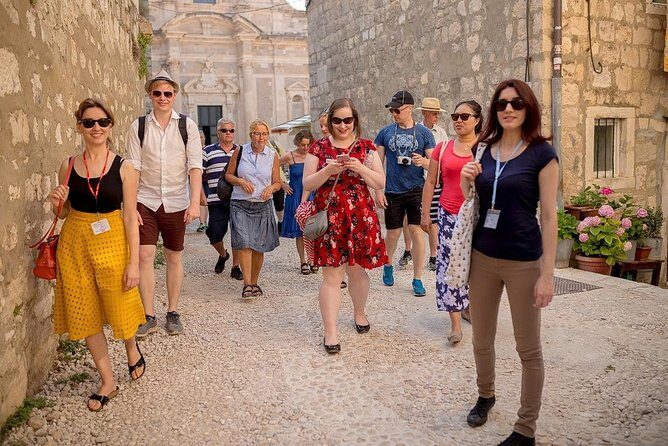
Next comes Ruđer Bošković Square, a central public space named for Dubrovnik’s famous son: Ruđer Bošković, known as a physicist, astronomer, mathematician, philosopher, diplomat, poet, theologian, and Jesuit priest. Even if that’s a mouthful, the point is simple: Dubrovnik wanted big ideas, not just big walls.
From there, you head to the Rector’s Palace, once the seat of the Rector of the Republic of Ragusa—Dubrovnik’s name in the Middle Ages when it was a prosperous maritime republic. The building’s Gothic-Renaissance style helps you see how a trading power blended older medieval forms with newer European influences.
This section works well if you like history told in plain language. You’re not sitting through a lecture; you’re walking past the places where decisions were made. It also sets up why later landmarks matter: Dubrovnik wasn’t only a backdrop for food. It was a system.
Saint Blaise and Stradun: the city’s symbols you’ll pass again later
You’ll stop at the Church of Saint Blaise, Dubrovnik’s Baroque church dedicated to Sveti Vlaho, the city’s patron saint. The church is one of the most cherished religious and architectural landmarks, and it’s a good moment to understand why Dubrovnik’s identity is tied to protection, prayer, and public devotion.
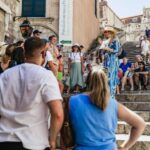
Then you move to Stradun (Placa), the main street and the city’s pedestrian spine. It’s about 300 meters long, paved in limestone, and runs between Pile Gate and Ploče Gate through the heart of the UNESCO-protected Old Town. If you’ve ever felt lost in Stradun crowds, this tour helps you learn the street by using it.
And right along that route you’ll find the Orlando Column, a limestone pillar erected in 1418 with a statue of Orlando (Roland), the medieval knight tied to local legend. The column wasn’t just decorative. It was used for public announcements, symbolized justice, and even served as a unit of measurement for local cloth sellers. That means you’re seeing a civic tool, not only a photo spot.
Gundulić Square Market and Sponza Palace: where trade becomes daily life
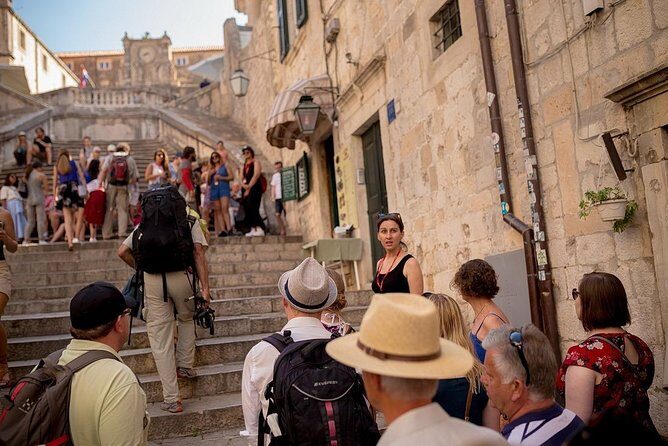
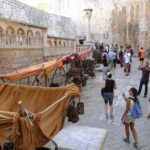
The tour shifts from grand monuments to everyday city movement at Gundulićeva Poljana Market (Gundulić Square Market). It’s an open-air market in the heart of the Old Town that turns into a lively trading space each morning. Named after poet Ivan Gundulić, the square is one of those places where you can almost imagine daily conversation and buying decisions.
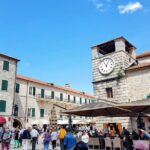
Then you reach Sponza Palace (Divona), one of Dubrovnik’s most beautiful historic buildings, located near the bell tower at the end of Stradun inside the iconic walls. Sponza is tied to the city’s long trading life, so it’s a natural bridge to the food you’re about to taste.
This pairing is smart for two reasons. First, it stops the tour from becoming only a list of monuments. Second, it gives you a sense of how commerce and culture mix in Dubrovnik—food isn’t separate from economics here. It’s part of the same story.
You can also read our reviews of more food & drink experiences in Dubrovnik
Porat Dubrovnik and the Cathedral: maritime wealth meets spiritual power
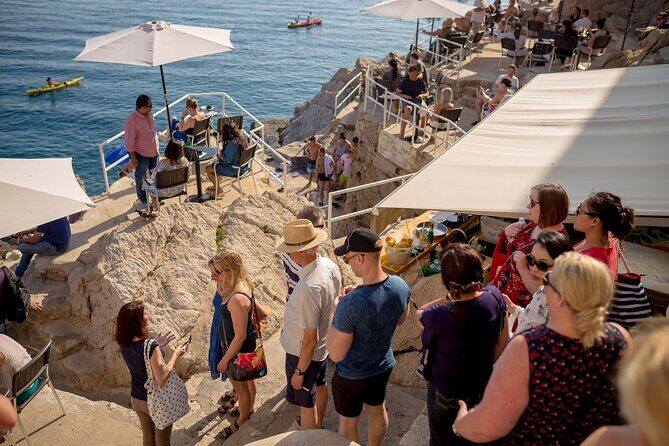
Next is Porat Dubrovnik, the Old Port or city harbor area in the eastern section of the city. This is where Dubrovnik’s maritime identity becomes physical: the harbor was a hub for trade and commerce, connecting the Adriatic “Pearl of the Adriatic” with Mediterranean ports and beyond.
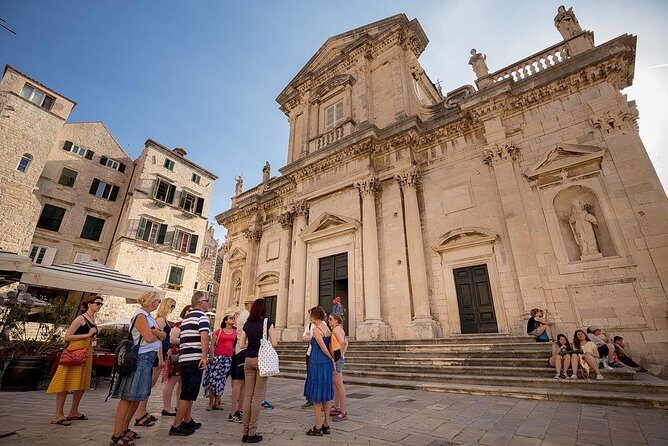
After the port story, the route brings you to the Cathedral of the Assumption of the Virgin Mary. The cathedral is Baroque and one of the city’s most iconic landmarks. It’s a good contrast after the practical energy of the port—less about movement of goods, more about what people built to express belief and community.
If you want your food tour to feel more meaningful, this is where it clicks. Dubrovnik’s cuisine makes sense when you understand the city’s priorities. People fed crews, welcomed visitors, and celebrated identity. A port city develops flavors and habits shaped by contact, movement, and pride.
Orthodox Church of the Annunciation and Dubrovnik’s bell tower: a skyline with two stories
You’ll also visit the Orthodox Church of the Annunciation, the Serbian Orthodox church in Dubrovnik’s Old Town. It shows a blend of architectural influences, melding Byzantine and Southern Adriatic styles. This is a useful stop because Dubrovnik wasn’t sealed off; it absorbed and reflected different traditions.
Finally, you reach the Bell Tower, a tall landmark standing 31 meters high at the eastern end of Stradun. It was originally built in 1444 and reconstructed in 1928 after the earlier structure began to lean. That detail matters: Dubrovnik has a habit of rebuilding, and the city’s landmarks are part of that long repair story.
By the end of the walk, you’ve seen the city’s civic symbols, religious centers, trading links, and architectural endurance. That’s what makes the later meal stops land. They feel like a continuation of what you just saw.
What’s actually on the menu: barley with shrimps, Pag cheese, kopun salad, carob cake
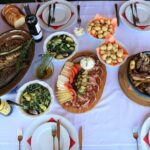
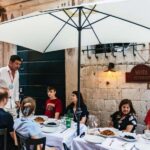
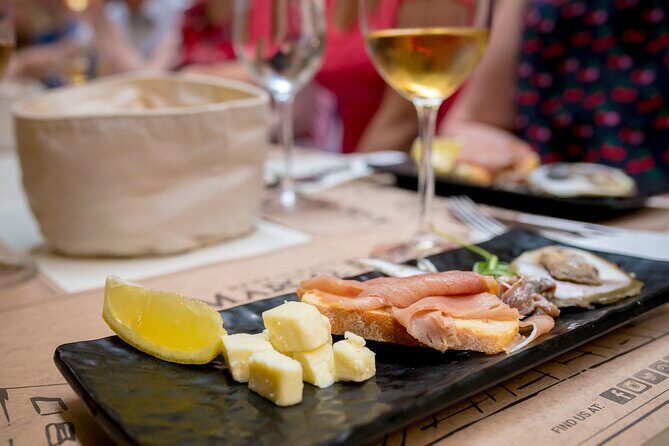
Food-wise, the tour menu is built around regional ingredients and classics. Expect at least four tasting moments connected to restaurant stops. The sample menu includes:
- Starter: Kopun salad, served with seasonal fresh veggies and fruits
- Main: Creamy barley with Adriatic shrimps, served with cheese from the island of Pag
- Another main: (served as part of the second main course stop)
- Dessert: Dubrovnik carob cake with wild bitter orange jam
You’ll also get coffee and/or tea with the experience, plus bottled water at three stops.
Wine is part of the pacing: you’ll have a glass of red or white wine at three stops, and then a glass of local brandy or liqueur with dessert on the final tasting stop. It’s a nice structure because you’re not guessing when the alcohol is coming; it arrives with the food when it makes sense.
One practical note: the tour offers a vegetarian option if you request it in advance. A vegan option is not available, and the tour is not recommended for vegans. If you’re vegetarian, tell them early so you get something that fits your needs.
Alcohol, pace, and what to wear so you enjoy every stop
Because wine and liqueur are scheduled, pace matters. Eat slowly at each tasting stop, and save room for dessert. Carob cake plus bitter orange sounds like a small thing until you actually taste it—carob desserts can be surprisingly filling.
The walk itself is on stone streets and through crowded Old Town areas. You’ll likely spend time standing at sights before some of the meals. If you’re the type who gets impatient with explanations while standing, plan for that. The good news is that the explanations are tied directly to what you’re about to eat, not random trivia.
For clothing, go for layers. This tour runs in all weather conditions, so bring a light jacket or rain layer. Also, hydration helps. You’ll have bottled water on the tour, but it’s still smart to come prepared for Dubrovnik’s sun and wind.
If you’re traveling with dietary constraints beyond vegetarian, advise them at booking. The tour specifically asks for dietary requirements in advance, which is how you prevent awkward replacements.
Why this tour feels like an inside track in Dubrovnik
A big part of why people rave about this tour is that it’s not only about food. The route is packed with landmarks that connect to Dubrovnik’s identity, from water infrastructure at Onofrio’s Fountain to the civic symbolism of the Orlando Column.
Small-group size helps here. With max 12 travelers, the guide can keep the group together, answer questions, and encourage conversation without the tour feeling like a conveyor belt. That’s why guides are often praised in the feedback, including names like Anna and Dražen.
Another useful detail: some people mention getting follow-up recommendations afterward by email. In a city loaded with restaurant choices, that kind of guidance can save you time.
If you’re trying to decide what to do early in your trip, this is a strong candidate. You learn where the key historic sights are, and you also get direct restaurant ideas while the flavors are still fresh in your head.
Value check: is $175.35 a good deal?
At $175.35 per person for roughly 3 hours, the value depends on what you’d otherwise spend on food and drinks. This tour bundles a local guide, multiple planned tasting stops, and drinks: wine at three stops, liqueur with dessert, coffee/tea, and bottled water at multiple points.
So you are paying for convenience plus structure. You’re not shopping for menus in a busy Old Town moment, and you’re not coordinating a route across several reservations. You’re also getting the connection between the city and the dishes, which is the part that makes a food tour feel more than just eating.
If you are the kind of traveler who likes to plan meals tightly and avoid surprises, this setup is a good match. If you’re on a super strict budget and only want small snacks, you might feel the price more than a buffet-style tour would.
Who should book this, and who might skip it
Book this tour if you want a mix of history on foot and food that’s tied to Dubrovnik’s regional identity. It fits well for couples, first-timers, and solo travelers who like meeting people in a small group. It’s also great if you’re excited to try dishes like kopun salad and creamy barley with Adriatic shrimps, plus carob cake with wild bitter orange jam.
You should think twice if:
- You need a fully vegan meal plan (vegan option is not available)
- You prefer lots of tiny samples with minimal standing
- Long explanations while in crowded areas are your least favorite travel style
Should you book this Dubrovnik Food and Drink Walking Tour?
Yes, if you want to learn and eat in the same motion. This tour’s best strength is the way it uses the city as the storyline while you taste the food and drinks that go with it. Between the planned tastings, wine schedule, and route through major landmarks like Stradun, the Rector’s Palace, and the Cathedral, it gives you a fuller Old Town experience than a meal alone.
I’d book it early in your stay. You’ll leave with a better sense of where things are and what kind of dishes to seek next. Just make sure you plan for the walk time, bring good footwear, and check your diet needs up front—especially if you are vegan.
If that all sounds good, this is the kind of tour that makes Dubrovnik feel personal fast.
FAQ
How long is the Dubrovnik food and drink walking tour?
It lasts about 3 hours.
What language is the tour offered in?
The tour is offered in English.
Is the price inclusive of food and drinks?
Yes. Food tastings and drinks are included, including starter, two mains, dessert, coffee and/or tea, bottled water, and alcoholic beverages.
What is the maximum group size?
The tour has a maximum of 12 travelers.
Where does the tour start?
The meeting point is Poljana Paska Miličevića, 20000, Dubrovnik, Croatia.
Is there a vegetarian option?
Yes. A vegetarian option is available if you advise the provider at booking.
Is there a vegan option?
No. Vegan option is not available, and the tour is not recommended for vegans.
Does it operate in bad weather?
It operates in all weather conditions, so you should dress appropriately. If canceled due to poor weather, you’ll be offered a different date or a full refund.